Hot topic · Prayer and Scripture
Spain train crash near Toledo: what happened, and a prayer for the victims
On the morning of Wednesday, October 28, 2026, a high-speed train travelling from Madrid to Seville struck the back of another train that had stopped on the line near Urda, in Spain’s Toledo province. By that evening the regional government counted at least 68 dead, and dozens were seriously injured. It is Spain’s second deadly high-speed crash this year. Spain’s government declared three days of official mourning, from October 29 to 31, and Spain’s bishops asked for prayer for the victims in the Church’s celebrations. Below is what has been reported so far, with dates and sources, a prayer for the dead, the injured and their families, the Scripture Christians turn to after a disaster, and a short reflection on the question many people are asking: where was God?
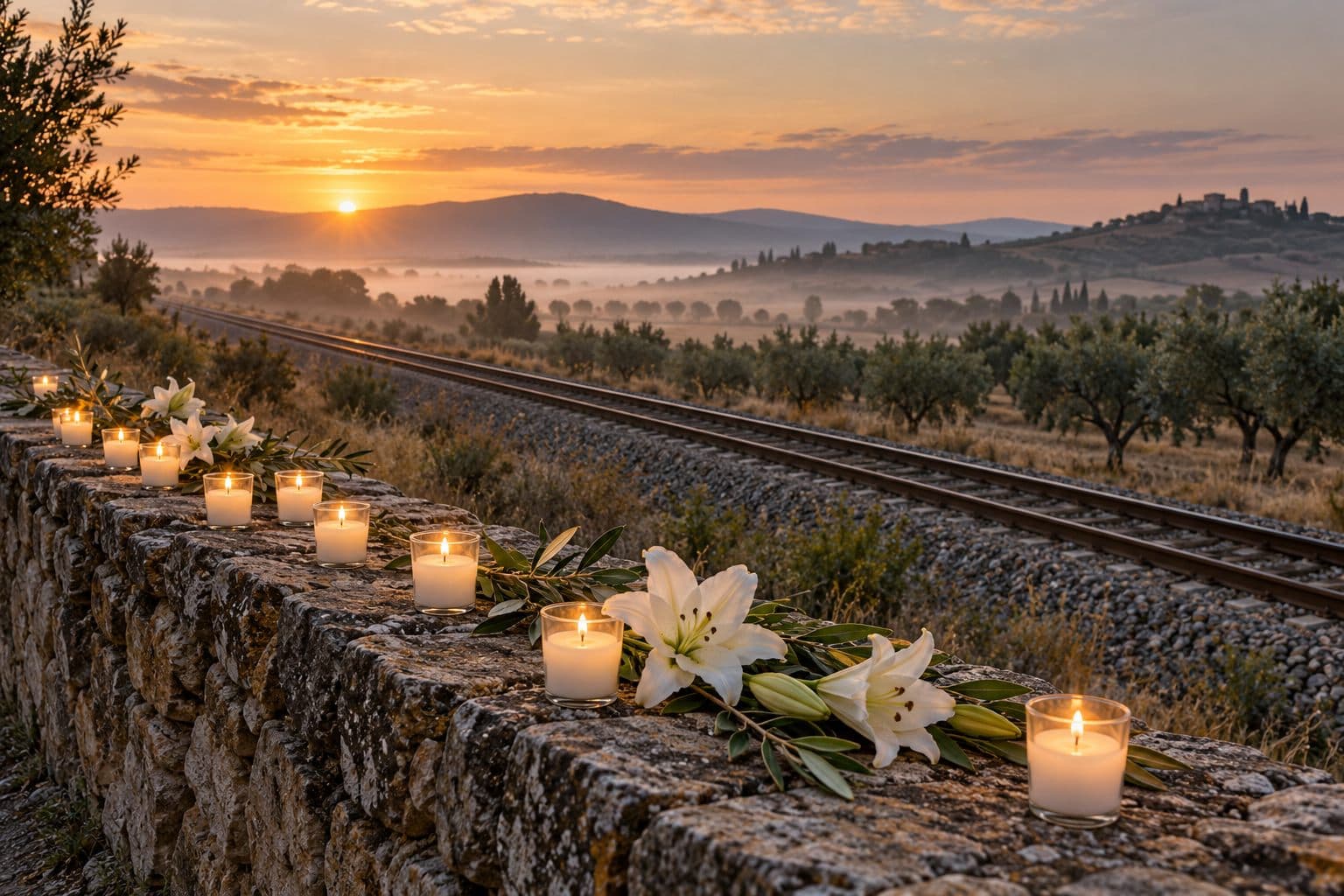
What happened near Urda
The collision. An AVE train run by the state operator Renfe, carrying 397 passengers from Madrid to Seville, struck the rear of a train run by the private operator Iryo, carrying 147 passengers, which had stopped on the same line. Two carriages derailed, and according to emergency sources quoted by El País, two Iryo carriages fell down an embankment (Al Jazeera, October 28, 2026). Rome Reports gave the time of the collision as 8:53 a.m.
The toll. By the evening of October 28 the regional government of Castilla-La Mancha reported at least 68 dead. Al Jazeera reported about 80 injured, about 50 of them seriously and 15 critically, and the regional president, Emiliano García-Page, warned that some of the most seriously injured might not survive. Other outlets gave higher injury figures; Euronews reported more than 100 injured. The numbers differ between reports and may still change.
What is known about the cause. Transport Minister Óscar Puente said the signalling control system failed along a stretch of about 63 kilometres around Urda that morning and that several trains were stopped. Control passed to the Atocha control post in Madrid, which allowed the Renfe train to continue. Puente called that decision “inexplicable” and said, “The decision to resume traffic without the system having been restored corresponds to the control centre” (Al Jazeera). The Civil Guard sent a disaster investigation team, and high-speed services between Madrid and Andalusia were suspended. The investigation is at an early stage; this page will not assign blame to any person.
Spain’s response. “Spain is in mourning,” Prime Minister Pedro Sánchez said, promising that “if there was negligence, it will be revealed” (Al Jazeera). More than 200 members of the Military Emergencies Unit worked at the site, and the nearby town of Los Yébenes collected food and supplies for those affected. European Commission President Ursula von der Leyen wrote, “Today, Europe mourns with you.” The crash came nine months after the collision near Adamuz, in Córdoba province, on January 18, 2026, which killed 46 people (Al Jazeera).
What Spain’s bishops and priests said
- The Spanish bishops’ conference sent its “condolences and closeness to the families of the victims,” prayed “for the eternal rest of the deceased and for the recovery of the injured,” and asked “for prayer in the celebrations of the Christian community for all the victims” (OSV News, from Alfa y Omega, October 28, 2026).
- Archbishop Francisco Cerro of Toledo and Auxiliary Bishop César García Magán said they “wish to express their deep concern and their closeness to all those affected,” and placed the archdiocese’s Caritas and the parishes of Urda and Los Yébenes at the service of the victims and their families (OSV News). Rome Reports said the archbishop went to the centre where the injured and their families were being cared for.
- Father José Miguel Fernández, parish priest of Urda, opened the parish buildings to help and said “the first thing is to offer them encouragement and show them the support of the Church, the comfort of God” (OSV News). He told Rome Reports he was trying “to take them by the hand.”
- Other bishops also wrote. Bishop Ginés García Beltrán of Getafe prayed “May the Lord sustain and comfort those affected,” and Bishop José Ignacio Munilla of Orihuela-Alicante quoted the ancient prayer “Grant them, O Lord, eternal rest, and let perpetual light shine upon them” (OSV News).
We found no statement from Pope Leo XIV on this crash as of the morning of October 29 (Malaysia time). After the Adamuz crash in January he sent a telegram offering “prayers for the eternal rest of the deceased” (OSV News, January 19, 2026).
A prayer for the victims of the Toledo train crash
Lord Jesus Christ, you wept at the grave of your friend, and you are the resurrection and the life. We pray for the men, women and children who died near Urda, who set out on an ordinary morning and did not come home. Receive them in your mercy, and give them rest where there is no pain, no sorrow and no sighing. Heal the injured; steady the hands of the doctors, nurses, soldiers and firefighters who care for them; and stay close to every family waiting by a phone or a hospital bed. Comfort the people of Urda, Los Yébenes and all of Spain, mourning for the second time this year. Give the investigators wisdom and honesty, and give those who carry any part of the blame the courage to tell the truth. Do not let grief turn into despair, nor anger into hatred. Amen.
This prayer is original to this page and may be prayed by Christians of any tradition. Catholics and many Anglicans may also pray the Eternal Rest prayer that Bishop Munilla quoted; Orthodox Christians the Orthodox prayer for the departed. More prayers are gathered in prayers for the dead and for funerals and prayers in grief.
What the Bible says after a disaster
God is near the grieving. The first word Scripture gives to mourners is not an explanation but a presence:
18 The Lord is nigh unto them that are of a broken heart; and saveth such as be of a contrite spirit.
Before he raised Lazarus, “Jesus wept” (John 11:35). He knew what he was about to do, and he wept anyway. Christians are not asked to hide grief behind quick answers. “Blessed are they that mourn: for they shall be comforted” (Matthew 5:4).
The victims were not being punished. Jesus was once told about Galileans killed by Pilate, and he added a second disaster himself: eighteen people crushed when a tower fell in Jerusalem. His answer:
4 Or those eighteen, upon whom the tower in Siloam fell, and slew them, think ye that they were sinners above all men that dwelt in Jerusalem? 5 I tell you, Nay: but, except ye repent, ye shall all likewise perish.Read Luke 13 in context · King James Version →
Jesus flatly rejects the idea that people who die in an accident were worse than anyone else. He also refuses to let the living treat disaster as someone else’s story: life is short and uncertain for everyone, and every death calls the rest of us to turn to God while we can.
Nothing can separate the believer from God’s love.
38 For I am persuaded, that neither death, nor life, nor angels, nor principalities, nor powers, nor things present, nor things to come, 39 Nor height, nor depth, nor any other creature, shall be able to separate us from the love of God, which is in Christ Jesus our Lord.
The end of the story. The Bible’s last picture of death is its defeat:
4 And God shall wipe away all tears from their eyes; and there shall be no more death, neither sorrow, nor crying, neither shall there be any more pain: for the former things are passed away.Read Revelation 21 in context · King James Version →
How Christian traditions pray for the dead
Catholic. Spain is a largely Catholic country, and its bishops have asked for prayer for all the victims in the Church’s celebrations. Catholics pray for the departed and offer Mass for them, trusting them to God’s mercy. The mourning falls just before All Saints and All Souls (November 1 and 2), when the whole Church prays for the dead.
Orthodox. Orthodox Christians pray for the departed by name and hold memorial services after the funeral, asking God to give them rest in a place “whence all sickness, sorrow and sighing have fled away” (the prayer “O God of spirits” in Isabel Hapgood’s 1906 translation).
Protestant. Most Protestant churches do not pray for the souls of the dead, believing their state is settled at death, but they pray for the injured and the bereaved and commend the grieving to God. Some Anglicans and Lutherans commend the departed to God in prayer.
These are general summaries; for what each church teaches about death and what follows, see What happens when we die?
Our reflection: where was God?
This is our own view, offered carefully on a day of grief, and some readers will see it differently.
We do not think anyone should say this crash was “God’s will” in the sense that God wanted 68 people dead on a Wednesday morning. Jesus refused that reading of the tower of Siloam, and so should we. The early reports point to a failed system and a human decision, the kind of failure that belongs to us, not to heaven. That matters: it means the families are right to demand answers, and Christians should stand with them in demanding the truth, not hurry them past it with talk of mysterious providence.
Where was God? The Christian answer is not an explanation but a person: in the parish priest of Urda taking strangers by the hand, in the emergency crews at the line and everyone caring for the injured, and above all with the dying, because the God Christians worship has himself died. That does not make the loss smaller. It means no one in those carriages was alone.
Over to you
When a disaster like this happens, what has actually helped you or someone you love: a verse, a prayer, a person who simply turned up? Or what have well-meaning Christians said that hurt instead? Share it below; someone grieving today may need to read it. You can also leave the name of someone you are praying for.
Comments
No comments yet. Start the conversation; comments are public and checked for spam. How comments are handled