Hot topic · Scripture and the traditions
Is there such a thing as a holy war? What the Bible says, after Pope Leo’s Assisi message
No: in the New Testament there is no holy war, and almost every church today agrees. The Old Testament does record wars God commanded, above all Israel’s conquest of Canaan, but Christians of every tradition read those as a unique, closed chapter, not a model for any nation since. Jesus told Peter to put his sword away and said his kingdom is not of this world. Where churches still differ is on a different question: whether a war can ever be just. Catholics, Orthodox, Lutherans, Reformed and Anglicans have said a defensive war can be right; Mennonites, Quakers and other peace churches say a Christian may not fight at all. Below: what Pope Leo XIV said on October 27, what the Bible says and does not say, what each tradition teaches, and our own view.
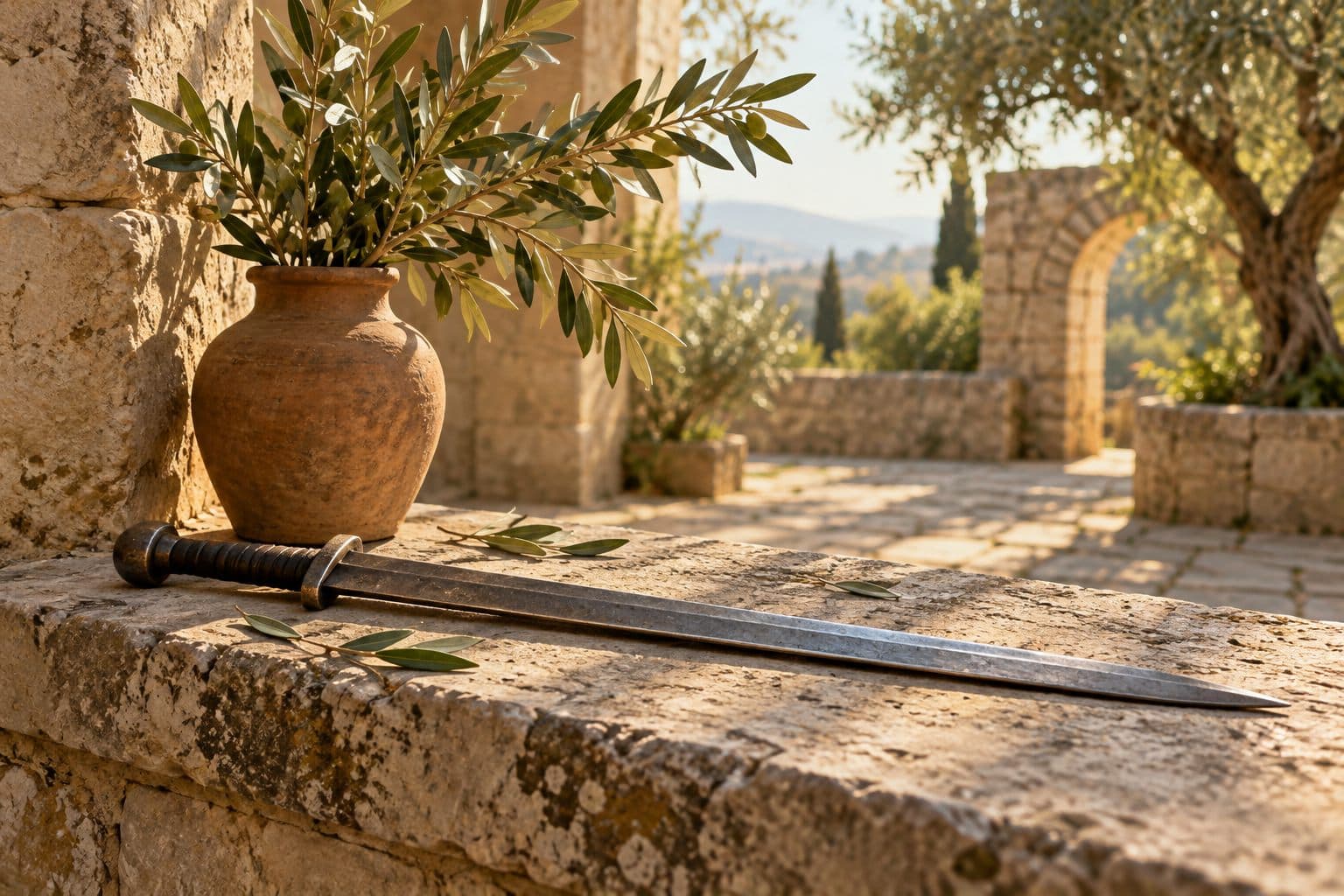
The short answer
A “holy war” means a war fought for God: one whose cause is religious and whose fighters are told that God wants it. The Bible has such wars only in one setting, ancient Israel’s entry into the land, and even there God refuses to be anyone’s mascot. When Joshua asked the armed figure near Jericho, “Are You for us or for our enemies?”, the answer was “Neither” (Joshua 5:14). In the New Testament, Jesus stops the one disciple who fights for him (Matthew 26:52), and the apostles say the Christian’s war is “not against flesh and blood” (Ephesians 6:12).
That leaves a narrower question that Christians still argue about: may a Christian ever fight, for example to defend a country that has been invaded? Most churches have said yes, under strict conditions; the peace churches say no. Neither side calls such a war holy.
Our own view, argued in Our take below: Pope Leo is right that no war is holy, and anyone who blesses a war as God’s cause is misusing his name. But we think he goes too far in calling the just war tradition “outdated.” Its job was never to make wars holy. Its job is to tell Christians when a war is wrong, and the world still needs that.
Why it is in the news
On Tuesday, October 27, 2026, Pope Leo XIV sent a video message to the International Meeting for Peace in Assisi, organized by the Community of Sant’Egidio to mark forty years since Pope John Paul II first gathered religious leaders there to pray for peace in 1986. He had planned to go in person but stayed in Rome on his doctors’ advice while recovering from his October 13 lung surgery (EWTN Vatican; Associated Press, via NBC News, October 27, 2026). “War can never be waged in the name of God,” he said, and: “There is no such thing as a holy war: only peace is holy.” He called for “a rejection of the religious justification of war” and said, “We must rebuild peace everywhere, not prepare for more wars” (Vatican News, October 27, 2026).
The Pope named no conflict. The Associated Press report noted the background: Russia’s Orthodox Church has called the invasion of Ukraine a “holy war,” and leaders on all sides of the war with Iran have used religious language for their actions. In March 2024 the World Russian People’s Council, chaired by Patriarch Kirill of Moscow, adopted a decree describing the war in Ukraine as a “Holy War.” The World Council of Churches answered that it could not reconcile that language with what Kirill had told its general secretary in May 2023, when he agreed that “no war of armed violence can be ‘holy’” (WCC statement, April 12, 2024).
The October message repeated a line from Leo’s first encyclical, Magnifica Humanitas (May 15, 2026): “to fight in the name of religion means attacking religion itself” (no. 223). The same encyclical also said that, “without prejudice to the right to self-defense in the strictest sense,” the “just war” theory, “which has all too often been used to justify any kind of war, is now outdated” (no. 192). That second sentence is the one Catholic writers are still arguing about, and we return to it below.
The wars of the Old Testament
Anyone who says “the Bible has no holy war” has to face the book of Joshua. Israel’s laws of war in Deuteronomy 20 tell them to offer peace to distant cities (Deuteronomy 20:10), but in the cities of the land itself, “you must not leave alive anything that breathes” and “must devote them to complete destruction” (Deuteronomy 20:16–17, BSB). The Hebrew term for that devotion is ḥerem: the spoils and people of the city were given over to God, not taken as loot. Saul is later rejected as king for disobeying such an order against the Amalekites (1 Samuel 15). These are some of the hardest passages in Scripture, and every honest reader should say so.
Three features of the texts themselves limit them. First, they are tied to one land, one people and one moment: Deuteronomy 20 separates the cities of Canaan from all other wars, and no later book extends the command to any nation beyond those the Law already named. Second, the texts deny that Israel fought because it was better: “It is not because of your righteousness… but it is because of their wickedness” (Deuteronomy 9:5). Third, God is not Israel’s war god. Before Jericho, Joshua meets the commander of the Lord’s army:
13 Now when Joshua was near Jericho, he looked up and saw a man standing in front of him with a drawn sword in His hand. Joshua approached Him and asked, “Are You for us or for our enemies?” 14 “Neither,” He replied. “I have now come as Commander of the LORD’s army.” Then Joshua fell facedown in reverence and asked Him, “What does my Lord have to say to His servant?”Read Joshua 5 in context · Berean Standard Bible →
The question is not whether God is on Joshua’s side but whether Joshua is on God’s. The prophets then look past war altogether, to a day when nations “will beat their swords into plowshares” and “nor train anymore for war” (Isaiah 2:4; Micah 4:3).
Christians do not agree on how to read the conquest accounts. Many Catholic, Orthodox and Protestant interpreters take them as real commands for a unique moment in the history of salvation that can never be repeated. Others, among them some Catholic and evangelical scholars, read the language of total destruction partly as the stylized war rhetoric of the ancient Near East. Early writers such as Origen read the wars as figures of the soul’s fight against sin. All three readings agree on the point that matters here: none makes Joshua a template for a Christian nation.
What Jesus and the apostles changed
- The sword in the garden. When Jesus was arrested, one of his companions cut off a servant’s ear. Jesus answered, “Put your sword back in its place… For all who draw the sword will die by the sword” (Matthew 26:51–52, BSB). The one time a disciple fought for Jesus himself, Jesus stopped him.
- A kingdom that does not fight. Before Pilate he said: “My kingdom is not of this world; if it were, My servants would fight to prevent My arrest” (John 18:36, BSB). The kingdom of God is not advanced by armies.
- Love of enemies. “Love your enemies and pray for those who persecute you” (Matthew 5:44); “Blessed are the peacemakers” (Matthew 5:9). Pope Leo quoted the peacemakers line in his message.
- A different war. “We do not wage war according to the flesh. The weapons of our warfare are not the weapons of the flesh” (2 Corinthians 10:3–4); “our struggle is not against flesh and blood, but… against the spiritual forces of evil” (Ephesians 6:12). The New Testament keeps the language of holy war and turns it inward and upward.
- Vengeance belongs to God. “Do not avenge yourselves, beloved… ‘Vengeance is Mine; I will repay, says the Lord’” (Romans 12:19).
Two passages pull the other way, and both sides of the Christian argument use them. The ruler “does not carry the sword in vain. He is God’s servant, an agent of retribution to the wrongdoer” (Romans 13:4): the state may use force. And when soldiers asked John the Baptist what they should do, he did not tell them to leave the army; he told them not to extort money and to be content with their wages (Luke 3:14). Those who accept a just war read these as permission for force under authority; the peace churches read them as describing the state, not the church.
“Put your sword back” in five editions
The five public-domain Bibles we quote agree closely on Jesus’s words to Peter. The older translations keep “perish with the sword,” the newer ones “die by the sword.”
| Edition | Matthew 26:52 |
|---|---|
| Berean Standard Bible | “Put your sword back in its place,” Jesus said to him. “For all who draw the sword will die by the sword. |
| World English Bible | Then Jesus said to him, “ Put your sword back into its place, for all those who take the sword will die by the sword. |
| American Standard Version | Then saith Jesus unto him, Put up again thy sword into its place: for all they that take the sword shall perish with the sword. |
| King James Version | Then said Jesus unto him, Put up again thy sword into his place: for all they that take the sword shall perish with the sword. |
| Original Douay–Rheims | Then Jesus saith to him: Return thy sword into his place: for all that take the sword shall perish with the sword. |
The saying is a rebuke in context, not a general statement of military policy, which is why Christians who accept just war and those who reject all war both quote it. What it rules out, at least, is fighting for Jesus. Read it in context in the KJV.
What the Bible does not say
- It never gives any nation after Israel a mandate to fight for God. No passage makes any later empire, kingdom or republic the heir of Joshua’s commands.
- It does not make Christ’s return a war Christians fight. Revelation pictures the rider called Faithful and True, who “with righteousness He judges and wages war” (Revelation 19:11). That war is fought by Christ himself, and the weapon is the sword “from His mouth” (Revelation 19:15), not by any army on earth.
- “Two swords” is not a battle plan. At the Last Supper the disciples said, “Look, Lord, here are two swords,” and Jesus answered, “That is enough” (Luke 22:38). Hours later he told Peter to put one of them away. Medieval writers built a theory of church and state on this verse; the text itself does not carry it.
- It does not settle the just war question in a single verse. There is no proof text that says “Christians may fight in defensive wars,” and none that says “a Christian may never serve as a soldier.” Both positions are conclusions from many passages.
How Christians came to fight “for God”
The earliest Christians were wary of military service, and church rules of the early centuries treated killing in war seriously even when they did not forbid it. Basil of Caesarea, writing in the fourth century, said the Fathers did not count killing in war as murder, “I presume from their wish to make concession to men fighting on behalf of chastity and true religion,” but he advised that soldiers whose hands were not clean should stay away from communion for three years (Letter 188, canon 13). The Orthodox churches still keep that tension: they pray for armies and honor soldier saints, yet they have no formal teaching that a war can be holy.
In the West, Augustine developed the idea that a war could be just: fought by lawful authority, for a just cause, with right intention, to restore peace. Thomas Aquinas later set out the same conditions. A just war in this sense is never holy; it is a grim necessity that is permitted, not a cause God blesses.
The Crusades blurred that line. At the Council of Clermont in 1095, Pope Urban II called Western knights to go east and help Christians there, and the chronicler Robert the Monk, writing years later, records the crowd crying out, “It is the will of God! It is the will of God!” (in the Latin tradition, Deus vult). Pope John Paul II asked forgiveness on the Church’s behalf in 2000 for violence used “in the service of the truth,” and in 2001 he expressed sorrow to the Orthodox for the crusaders’ sack of Constantinople in 1204. The modern papal teaching that no war is holy grows out of that memory.
How churches differ
| Tradition | Can a war be holy? | Can a war be just? | Source |
|---|---|---|---|
| Catholic | No | Legitimate defense under strict conditions; Leo XIV calls the “just war” theory outdated but keeps strict self-defense | Catechism nos. 2307–2317; Magnifica Humanitas nos. 192, 223 |
| Orthodox | No formal teaching that one can be; the 2024 Moscow decree called the Ukraine war one, and was criticized | War is at best a tragic necessity; no formal just war theory | Basil, canon 13; WCC, 2024 |
| Lutheran | No | Yes: Christians may “engage in just wars” | Augsburg Confession, Article XVI (1530) |
| Reformed and Presbyterian | No | Yes, “upon just and necessary occasions” | Westminster Confession 23.2 (1646) |
| Anabaptist (Mennonite, Amish, Brethren) | No | No: the sword belongs to the state, “outside the perfection of Christ” | Schleitheim Confession, Article 6 (1527) |
| Quaker (Society of Friends) | No | No: Friends “utterly deny… all outward wars” | Declaration to Charles II (1660/61) |
Catholic. The Catechism of the Catholic Church says governments “cannot be denied the right of lawful self-defense, once all peace efforts have failed” (no. 2308), and lists strict conditions for “legitimate defense by military force”: the damage inflicted by the aggressor must be “lasting, grave, and certain”; all other means must have proved “impractical or ineffective”; there must be “serious prospects of success”; and the use of arms “must not produce evils and disorders graver than the evil to be eliminated” (no. 2309). The moral law stays in force during the fighting (no. 2312). Pope Leo’s Magnifica Humanitas keeps the right to self-defense “in the strictest sense” while calling the “just war” theory outdated (no. 192). Catholic commentators disagree on how much that changes: some read it as a rejection of the theory, others, including the moral theologian Tobias Winright writing in America magazine, note that the encyclical still reasons with just war criteria.
Orthodox. Orthodox theology has generally avoided a formal just war theory. It treats war as an evil that may sometimes be unavoidable, and it keeps Basil’s counsel of repentance for soldiers. That is why the 2024 decree of the World Russian People’s Council, chaired by Patriarch Kirill, drew sharp criticism from other churches. The World Council of Churches, of which the Russian Orthodox Church is a member, said it could not reconcile the decree’s “Holy War” language with Kirill’s own statement that no armed war can be holy (April 12, 2024). Many Orthodox Christians, in Ukraine and elsewhere, reject the decree.
Lutheran. The Augsburg Confession of 1530 teaches that Christians may hold civil office and, among other duties, “engage in just wars, to serve as soldiers” (Article XVI). It condemns the Anabaptists who forbade this. It also limits obedience to rulers: Christians must obey God rather than men when commanded to sin (Acts 5:29). Luther argued in Whether Soldiers, Too, Can Be Saved (1526) that a soldier’s calling could be a Christian one, and in On War Against the Turk (1529) that the emperor might defend his subjects but that a war should not be fought in the name of Christ or led by the church, as the crusades had been.
Reformed and Presbyterian; Anglican. The Westminster Confession says civil magistrates “may lawfully, now under the New Testament, wage war upon just and necessary occasions” (chapter 23, section 2). The Church of England’s Thirty-Nine Articles likewise say it is lawful for Christians, at the command of the magistrate, to bear arms and serve in wars (Article 37). Both place war under the state, never the church.
Anabaptist. The Schleitheim Confession of 1527, the founding statement of the Swiss Brethren, says the sword is ordained of God “outside the perfection of Christ”: it is the state’s tool for punishing the wicked, but inside the church only the ban (excommunication) is used (Article 6). Mennonites, Amish, Hutterites and the Church of the Brethren have since been “historic peace churches” and many of their members have served as conscientious objectors.
Quaker. In their 1660 declaration to King Charles II (dated by the old calendar; 1661 by ours), George Fox and eleven other Friends wrote that they “utterly deny… all outward wars and strife and fightings with outward weapons, for any end or under any pretence whatsoever.” It remains the foundation of the Quaker peace testimony.
Our take
This is our own view, not a ruling for any church, and some readers will disagree with it, including some who agree with the Pope on everything else.
Pope Leo is right: there is no holy war, and Christians should stop saying otherwise. The New Testament never repeats the conquest of Canaan. It turns the language of war toward sin and spiritual evil, and its one armed disciple is told to put his sword away. When a church body calls a nation’s invasion of its neighbor a “holy war,” as the Moscow decree did in 2024, it is not making a strong claim about Scripture. It is making a false one. The same goes for any politician, of any party or country, who presents a war as God’s cause. You may believe a war is necessary. You may not baptize it.
But “just war is outdated” goes too far. We agree with Leo that the theory has been abused to justify almost any war. The answer to abuse, though, is to apply the criteria honestly, not to retire them. The just war tradition never said a war was holy; it said most wars are wrong, and told Christians how to recognize the rare one that is not. Without it, a Christian whose country is invaded risks being left with two options: pacifism or no rules at all. The encyclical itself keeps self-defense “in the strictest sense,” and the Catechism’s four conditions in no. 2309 are exactly how a Christian tells strict self-defense from a war of conquest dressed up as one. That is the just war tradition doing its job.
The peace churches deserve more credit than they get. They have been right about the main point for five hundred years: Christ’s kingdom does not advance by the sword. We think they are wrong that a Christian may never serve in an army that defends the innocent; John the Baptist did not tell soldiers to quit (Luke 3:14). But a Mennonite who refuses to fight is far closer to the Gospel than a church that blesses the tanks.
Here is the test we would use. If a war is being described as holy, or as God’s will for our side, that is the clearest sign it is not just. A just war, if there is one, is fought with grief, with limits, with prayer for the enemy, and with the expectation of repentance afterward. Basil was right sixteen centuries ago: even a soldier in a just cause comes home with hands that need cleaning.
Over to you
Is there a war, past or present, that you believe Christians were right to fight, and how would you defend it without calling it holy? Or, if you hold with the peace churches, what would you say to someone whose home has just been invaded? Tell us below, and share this page with someone who sees it differently.
Comments
No comments yet. Start the conversation; comments are public and checked for spam. How comments are handled