Hot topic · Faith and culture
Is Bob Dylan a Christian? The gospel years, Pope Leo’s rosary, and what the Bible says about judging someone’s faith
Nobody outside Bob Dylan can say for certain, and he has never settled it in public. What the record shows is this: he was raised Jewish, he publicly professed faith in Jesus in 1979 and made three openly Christian albums, he then took part in Jewish religious life again from 1983, and in recent years he has called himself “a religious person” who reads the Scriptures, prays and lights candles in church, without joining any church that we know of. He has never, as far as we have found, publicly renounced the faith he sang about. In our view that makes him best described as a believer without a home church, and we explain below why we think the gospel years were real. Here is why the question is back, what the Bible says about judging another person’s faith, and how different Christians answer it.
Why this is in the news
On the afternoon of November 4, 2026, Pope Leo XIV received Bob Dylan, 85, in the Apostolic Palace. Vatican News described the meeting as “brief, consisting of greetings and a few lighthearted exchanges.” The pope gave Dylan a rosary; Dylan gave the pope a copy of his memoir, Chronicles: Volume One. Dylan, in Rome for a concert on November 5, came in a black hooded sweatshirt; AFP’s headline called him “black-clad.”
It was not a random photo opportunity. In July, the pope quoted Dylan’s unrecorded 1963 song “Go Away You Bomb” in his foreword to Disarmed and Disarming: Peace Is a Gift, a collection of his writings on peace, as America Magazine reported on July 24. And it was not Dylan’s first pope. In September 1997 he sang for John Paul II at the National Eucharistic Congress in Bologna. According to Vatican News, the pope then answered a question drawn from Dylan’s own songs: “There is only one road for man, and that is the road of Jesus Christ.” The future Benedict XVI, then Cardinal Ratzinger, later wrote that he had opposed the appearance; Reuters quoted his 2007 book: “There was reason to be skeptical — I was, and in a certain sense I still am.”
So the picture of the most famous convert in rock music holding a rosary from a pope sends people to the obvious question: is Bob Dylan actually a Christian?
What the record shows
Raised Jewish. Dylan was born Robert Zimmerman in 1941 in Minnesota and grew up in a Jewish family; he had his bar mitzvah, as Religion News Service summarised in 2011.
1979–1981: the gospel years. Rumours that Dylan had become a born-again Christian ran through 1979, and the album Slow Train Coming, released later that year, confirmed them. Writers on the period, including Timothy Bracy in InsideHook (2021), trace the turn to the Vineyard Fellowship, an evangelical church in California, which his girlfriend Mary Alice Artes had brought him to. The concerts that followed played no old hits at all, only the new gospel songs, with short sermons between them. Saved (1980) and Shot of Love (1981) continued in the same vein. Many fans were appalled; many Christians were thrilled. In 1983 Dylan told the Los Angeles Times, as Christianity Today reported, that he did not regret “telling people how to get their souls saved,” but that “now it’s time for me to do something else.”
From 1983: Jewish life again. In 1983 Time and Newsweek printed a photograph of Dylan at the Western Wall in Jerusalem for his son’s bar mitzvah, and he studied with members of the Lubavitch (Chabad) Hasidic movement while recording Infidels. Christianity Today’s January 1984 report quoted a Lubavitch rabbi in Brooklyn: “As far as we’re concerned, he was a confused Jew. We feel he’s coming back.” The same report quoted a former pastor and friend of Dylan’s who said the bar mitzvah did not mean he had returned to Judaism, and who added: “I don’t think he ever left his Jewish roots.”
Since then: his own words. Dylan has said little, and what he has said resists both camps. In 1997, around the album Time Out of Mind, he told Newsweek’s David Gates that he found “the religiosity and philosophy in the music,” and nowhere else, and that the old songs he loved were, in effect, his religion. In a December 2022 question-and-answer with the Wall Street Journal he said: “I’m a religious person. I read the scriptures a lot, meditate and pray, light candles in church.” He named no church and no creed.
Two things are missing from that record. We have found no public statement in which Dylan says he no longer believes in Jesus. And we have found no reliable report of him belonging to a church or synagogue in recent decades. Reports about his baptism and private practice exist, but we have not found them confirmed in a source we would rely on, so we leave them out.
What the Bible says
The Bible is surprisingly blunt about the limits of what we can know about anyone else’s faith. When Samuel was sure he had found Israel’s next king by looking at him, God corrected him:
7 But the LORD said to Samuel, “Do not consider his appearance or height, for I have rejected him; the LORD does not see as man does. For man sees the outward appearance, but the LORD sees the heart.”Read 1 Samuel 16 in context · Berean Standard Bible →
Paul says something similar about those who were judging his own ministry in Corinth:
5 Therefore judge nothing before the appointed time; wait until the Lord comes. He will bring to light what is hidden in darkness and will expose the motives of men’s hearts. At that time each will receive his praise from God.Read 1 Corinthians 4 in context · Berean Standard Bible →
Read in their places, neither passage forbids every judgement. Samuel still had to anoint someone, and Paul in the next chapter tells the Corinthians to deal with open, unrepented sin in their own church (1 Corinthians 5:12). What they forbid is the verdict on a heart, which belongs to God. The New Testament does give outward signs. Paul says that whoever confesses with his mouth “Jesus is Lord” and believes in his heart that God raised him from the dead will be saved (Romans 10:9), and Jesus says of teachers, “By their fruit you will recognize them” (Matthew 7:16). Dylan made that confession very publicly, on record and on stage, for three years.
The Bible also has two stories that fit a case like this, and they pull in opposite directions. In the parable of the sower, some seed falls on rocky ground: people “hear the word and at once receive it with joy,” but they “remain for only a season” (Mark 4:16–17). John writes of people who left the church that “if they had belonged to us, they would have remained with us” (1 John 2:19). On the other side, Paul writes that “He who began a good work in you will carry it on to completion” (Philippians 1:6), and Jesus tells of a shepherd who goes after the one sheep that was lost (Luke 15:4–7).
What it does not say
It does not say that a Jew who believes in Jesus stops being a Jew. The first believers were Jews, and the elders in Jerusalem told Paul that “many thousands of Jews have believed, and all of them are zealous for the law” (Acts 21:20). Paul himself had Timothy circumcised “on account of the Jews in that area” (Acts 16:3). So a photograph of Dylan at his son’s bar mitzvah, on its own, proves nothing either way. Attending a Jewish ceremony is not a renunciation of Jesus.
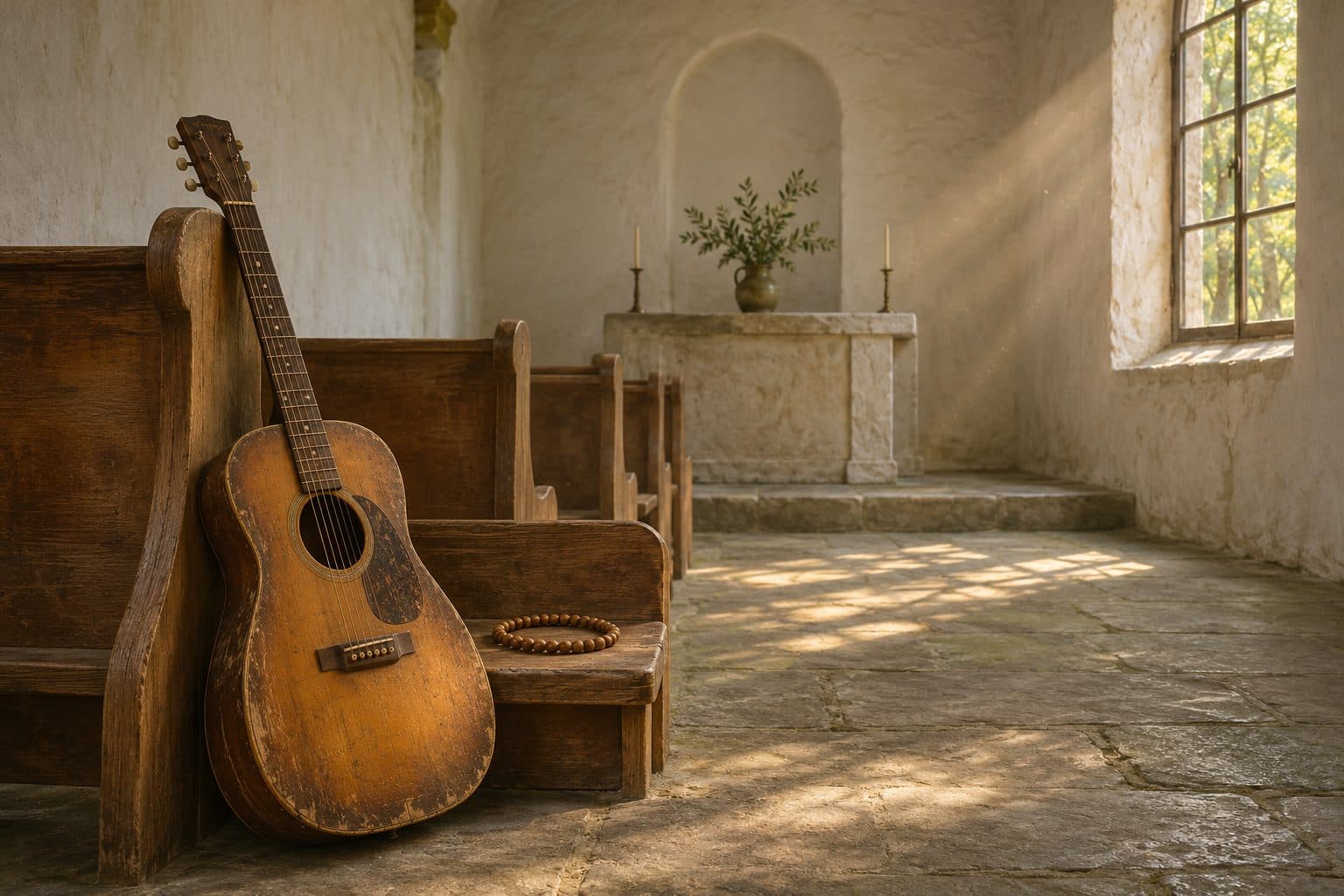
Nor does a rosary make anyone a Catholic. It is a gift a pope gives to many visitors, believers or not, and Vatican News described only greetings and a few lighthearted exchanges. It is a kind gesture, not a verdict.
And Scripture never makes church membership cards the test of faith, though it plainly expects believers to belong to a community: the letter to the Hebrews says, “Let us not neglect meeting together” (Hebrews 10:25). That verse is a reason to worry about a believer who keeps away from church. It is not a basis for declaring that he is not a believer.
How Christians differ
Reformed and many Baptist Christians. Those who hold the perseverance of the saints (Reformed) or eternal security (many Baptists) reason that a genuine conversion cannot be lost. Either Dylan’s 1979 faith was real and he is still a Christian, however he lives now, or it was never real. On that view the question is about 1979, not 2026.
Wesleyan, Pentecostal and other Arminian Protestants. These traditions hold that a true believer can fall away, so the question is about the present: does he still trust Christ? They tend to look at the later silence, the Chabad years and the lack of a church as warning signs, and to pray for a return rather than claim him.
Catholic. The Catholic Church teaches that baptism makes a person a Christian and that only God judges the state of a soul; it does not publish verdicts on individuals. Whether Dylan is a Christian in the Church’s sense turns first on a question the public record does not clearly answer, whether and how he was baptised.
Orthodox. Orthodox Christians speak of faith as a life lived in the Church, through baptism and the sacraments, rather than as a single moment of decision, and they too leave the judgement of a heart to God.
Messianic Jewish believers. For Jews who follow Jesus, Dylan’s path looks familiar rather than contradictory: a Jew can keep Jewish life and still believe Jesus is the Messiah. Many rabbis, on the other hand, see belief in Jesus as leaving Judaism, which is how the Lubavitch rabbi in 1984 could call him “a confused Jew” who was “coming back.” These are summaries in general terms; views vary within every tradition.
Our take
This is our opinion, not a report. We think Dylan’s conversion was real, that nothing he has said since takes it back, and that the fairest description of him today is a believer without a home church.
The case against that is serious, and we do not wave it away. A man who spends three years telling crowds they need to be saved and then goes quiet, studies with Chabad and calls the songs his religion fits the rocky ground of Mark 4 uncomfortably well. If the Wesleyans are right that faith can be lost, his silence is worth worrying about.
But the evidence leans the other way. He paid a real price for the gospel years: many fans walked away and the later gospel albums sold less well, yet he kept going for three records. He has never, as far as we can find, recanted. Asked in 2022 how he relaxes, a man with every reason to avoid the subject volunteered that he reads Scripture, prays and lights candles in church. A Jew who attends his son’s bar mitzvah has done nothing the first Jewish believers in Acts did not do. And Scripture’s own instruction is to “judge nothing before the appointed time.” The Christian habit of claiming Dylan as a trophy in 1979 and writing him off in 1983 was the wrong one both times.
Where we would push back is on the “no church” part. The Bible does not picture a believer on his own, and a faith that lives only in songs is a lonely one. Pope Leo’s rosary was a better answer than any argument: not a verdict, but an invitation.
Over to you
When you wonder whether someone well known is really a Christian, what do you look at first: what they said in their most public season of faith, how they have lived since, or whether they belong to a church, and why? Tell us below.
Comments
No comments yet. Start the conversation; comments are public and checked for spam. How comments are handled