Church year guide · Customs and Scripture
Advent wreath 2026: what the four candles mean, and when to light them
Light the first Advent candle on Sunday, November 29, 2026, and one more each Sunday after that: December 6, December 13 and December 20. In the Catholic custom, followed by many Anglicans and other Protestants, three candles are violet or purple and the fourth is rose, the pink candle lit on the third Sunday, Gaudete Sunday. The colours mark the church season; the popular names “hope, peace, joy and love” are a much later addition. The wreath itself is not in the Bible. It began in 1839 in a Lutheran home for poor children in Hamburg, as a wooden wheel with a candle for every day until Christmas. Below are this year’s dates, what each colour means, where the custom came from, how each tradition keeps it, and in Our take why we would keep the pink candle, drop the catalogue names, and keep the wreath from turning into early Christmas.
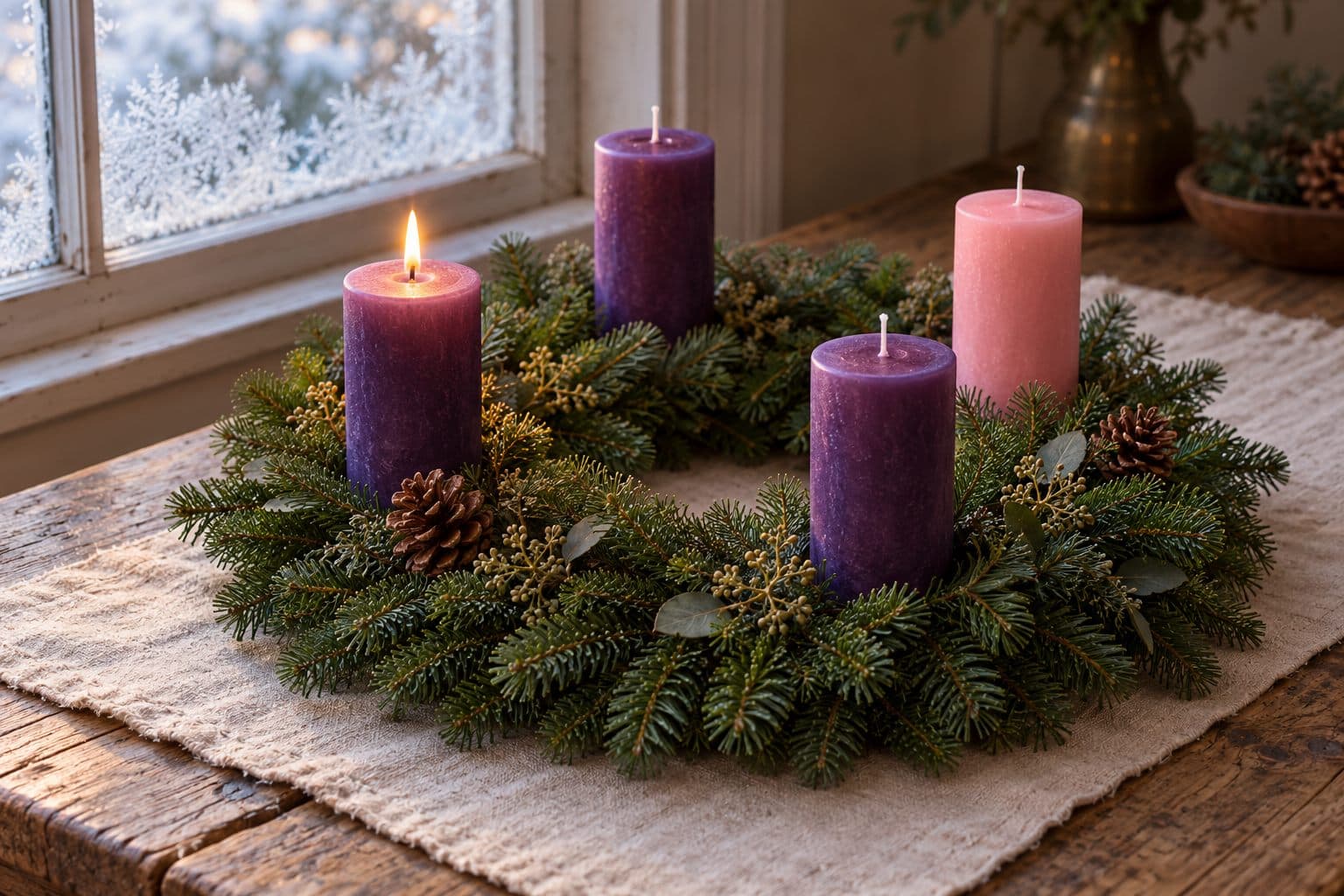
When to light the Advent candles in 2026
Advent begins on the fourth Sunday before Christmas. In 2026 that is November 29, and the season runs to Christmas Eve, Thursday, December 24.
| Day | Date | Candles lit (Catholic custom) |
|---|---|---|
| First Sunday of Advent | Sunday, November 29 | 1 violet |
| Second Sunday of Advent | Sunday, December 6 | 2 violet |
| Third Sunday of Advent (Gaudete Sunday) | Sunday, December 13 | 2 violet and the rose |
| Fourth Sunday of Advent | Sunday, December 20 | all four |
| Christmas Eve or Christmas Day | Thursday, December 24, or Friday, December 25 | all four, and a white centre candle if you have one |
The Catholic Book of Blessings places the blessing of a wreath on the First Sunday of Advent or on the evening before, so a household can bless and light its wreath on Saturday evening, November 28. The number of candles lit each week matches the week of Advent: one in the first week, two in the second, and so on. Many households relight the week’s candles every evening, and the Book of Blessings suggests the evening meal as a fitting time.
The Book of Blessings does not say which violet candle comes first; what matters is that the rose candle waits for the third Sunday. Some households add a white candle in the middle, usually called the Christ candle, and light it on Christmas Eve or Christmas Day.
For a short Bible reading for every day of the season, from November 29 to Christmas, use the site’s Advent readings 2026.
What the colours mean
Violet or purple. Violet is the church’s colour for Advent in the Catholic Church and in many Protestant churches, and priests wear violet vestments through the season. Catholic guides explain it as the colour of prayer, penance and preparation for Christ’s coming (Catholic News Agency, 2023). The Book of Blessings states the custom simply: “According to tradition, three of the candles are violet and the fourth is rose.”
Rose or pink. The rose candle belongs to the third Sunday, Gaudete Sunday, when the season turns from waiting toward joy (see below). Rose and pink are the same candle; “rose” is the church’s word, “pink” is the shop’s.
Blue. Many Lutheran and Methodist churches, and some Anglican and Episcopal ones, use blue for Advent as well as, or instead of, violet. The Lutheran Church–Missouri Synod’s planning guide for Lutheran Service Book lists the colour for each Sunday of Advent 2026 as “Blue or Violet.” The United Methodist Church says Advent candles are “usually purple or blue.”
White and red. The Book of Blessings also allows four violet or four white candles. The very first wreath had red candles for weekdays and white ones for Sundays, and red is still used today, especially in some British churches. Pope Benedict XVI, who was German, had a wreath with four red candles (U.S. Catholic, 2015).
Green. The evergreen branches stand for hope and life (Catholic News Agency, 2023). The colour belongs to the branches, not to the candles, and no rite sets it.
Hope, peace, joy, love: where the names came from
Most church websites and shop labels now name the four candles hope, peace, joy and love, sometimes with a fifth, the Christ candle. These names are not ancient, and no church’s liturgy assigns them. The United Methodist Church’s own answer, in its “Ask The UMC” series (2019), traces them to church supply houses in the mid-twentieth century, which printed weekly themes to go with the candles. It adds that the supply houses’ order was “Hope, Love, Joy, and Peace,” not the hope–peace–joy–love order most often printed today, and that the themes were written for the old one-year lectionaries, which few churches still use.
Other naming schemes circulate too, such as the Prophets’ (or Prophecy) candle, the Bethlehem candle, the Shepherds’ candle and the Angels’ candle. They are also modern devotional schemes, and their versions differ in the details. They can be useful for children. They are not what the candles “mean” in any official sense: the Catholic Book of Blessings says the candles represent the four weeks of Advent.
Why the third candle is pink: Gaudete Sunday
The third Sunday of Advent, December 13, 2026, is Gaudete Sunday. The name is the first word of the Latin entrance chant of that Sunday’s Mass, Gaudete in Domino semper, taken from Paul: “Rejoice in the Lord always. I will say it again: Rejoice!” and “The Lord is near” (Philippians 4:4–5, BSB). Past the halfway point of Advent, the church lets joy break through the waiting.
The Catholic Church’s General Instruction of the Roman Missal (no. 346) says rose “may be used, where it is the practice” on Gaudete Sunday and on Laetare Sunday in Lent. Many priests wear rose vestments that day, and the rose candle on the wreath matches them. That is the whole reason for the pink candle: it follows the vestments of one Sunday. The site’s Advent reading for that day, He will rejoice over you (Zephaniah 3:14–17, KJV), opens with the same note: “Sing, O daughter of Zion.”
Where the wreath came from
The wreath is younger than most people think. On the First Sunday of Advent in 1839, Johann Hinrich Wichern, a Lutheran pastor and theologian, hung a wooden ring about the size of a cartwheel in the prayer hall of the Rauhes Haus in Hamburg-Horn, a home he had founded for neglected children. The children kept asking how long it was until Christmas, so the ring carried a candle for every day: large white candles for the Sundays and small red ones for the weekdays. The number of red candles changed each year, from 18 to 24, because Advent has between 22 and 28 days. (In 2026, with 26 days from November 29 to December 24, Wichern’s ring would carry 4 white and 22 red.) Popular accounts differ on the exact count in the first year.
According to the German church weekly Sonntagsblatt, fir branches were first hung on the hall’s walls in 1851 and on the ring itself from 1860; Hamburg’s history museums also date the greenery, with white ribbons, to 1860. When the custom moved into ordinary homes in the early twentieth century, the ring had to shrink, and the weekday candles were dropped, leaving the four Sunday candles we know. Hamburg’s history museums report that the Wichern wreath is still lit on the first Sunday of Advent, as in the nineteenth century.
Wikipedia, summarising research by the Lutheran historian Mary Jane Haemig of Luther Seminary (“The Origin and Spread of the Advent Wreath,” Lutheran Quarterly, 2005), credits Wichern with the modern wreath and dates the spread: German Catholics took the custom up in the 1920s, and it reached North America in the 1930s. Catholics changed the candles to match the season’s vestments, three violet and one rose, as U.S. Catholic explained in 2015.
You will also read that the wreath began as a pagan winter custom of lighting candles to call back the sun; a 2023 Catholic News Agency explainer repeats it. We found no documented link between that winter custom and the wreath; the explainers that repeat it give no early evidence. The documented history of the Advent wreath begins with Wichern.
What the Bible says, and what it does not
The Bible does not mention an Advent wreath, Advent candles, or Advent at all. There is no verse about four candles, about purple and pink, or about keeping four Sundays before Christmas. The wreath is a nineteenth-century custom, and the season is a later church tradition, not a biblical command. Christians who keep it, and Christians who do not, are both free to on that score.
What the wreath does is act out two themes the Bible returns to again and again. The first is light growing in darkness. John opens his Gospel with it:
4 In him was life; and the life was the light of men. 5 And the light shineth in darkness; and the darkness comprehended it not.Read John 1 in context · King James Version →
Isaiah promises that “the people walking in darkness have seen a great light” (Isaiah 9:2, BSB), and Jesus says, “I am the light of the world” (John 8:12, BSB). A wreath that gets brighter each week as the nights get longer (in the northern hemisphere) puts those verses on the table.
The second is waiting for Christ’s coming. Advent looks back to his birth and forward to his return, and Jesus’ sayings about his return are about staying awake: “keep your lamps burning” (Luke 12:35, BSB), the ten virgins with their lamps and oil (Matthew 25:1–13), and “Keep watch!” (Mark 13:33–37, BSB). One of the two Gospels Lutheran Service Book gives for November 29, 2026, Mark 13:24–37, is from that chapter. Paul puts it most sharply: “The night is nearly over; the day has drawn near. So let us lay aside the deeds of darkness and put on the armor of light” (Romans 13:12, BSB).
So the wreath is a teaching aid, not a sacrament. Its meaning is only as good as the Scripture read beside it.
How each tradition keeps the wreath
Catholic. The wreath has an official blessing in the Book of Blessings (1989), in church and at home, where a parent or another family member may lead it. Three violet candles and one rose are the tradition; four violet or white are allowed. The rose candle is lit on Gaudete Sunday.
Anglican and Episcopal. Practice varies by parish. Many use three purple and one rose candle, like Catholics; others use four purple, four blue or four red, and some add a white centre candle for Christmas.
Lutheran. The wreath’s birthplace, in a Lutheran home in Hamburg. In the Lutheran Church–Missouri Synod, the Lutheran Service Book planning guide lists blue or violet for every Sunday of Advent 2026, the third included, with no separate rose Sunday.
Methodist. The United Methodist Church says candles are usually purple or blue, with rose or pink offered for the third Sunday. It does not prescribe the four names, and it suggests churches take each week’s theme from that Sunday’s Scripture readings.
Other Protestants. Practice varies most here. Many churches that do not otherwise follow the church year still light a wreath on the Sundays before Christmas, some with the hope–peace–joy–love names; others do not keep Advent at all.
Orthodox. The wreath is not part of Orthodox worship. Orthodox Christians prepare for Christmas with the forty-day Nativity Fast, beginning November 15. Some Orthodox families have adapted the Western wreath, with a candle for each Sunday of the forty-day fast and a centre candle for Christmas, as a home custom.
How to keep a wreath at home
You need a ring of evergreen branches (real or artificial), four candles and a safe holder. Bless and light it on Saturday evening, November 28, or on Sunday, November 29. Each evening that week, light one candle, read a short passage of Scripture, pray, and put it out. Add a candle each Sunday. Keep the wreath away from curtains, and never leave candles burning unattended; fresh branches dry out by December.
A simple order that fits any tradition: light the candles, read the day’s passage from the Advent readings, sit quietly for a minute, pray the Lord’s Prayer, and blow the candles out. In the last week, from December 17, the O Antiphons give seven short prayers for the evenings before Christmas.
Our take
This is our own view, not a ruling for any church. Many readers who love their wreath will disagree with part of it.
Keep the pink candle. It is the only candle that marks one particular Sunday: it follows the rose vestments of Gaudete Sunday and Paul’s “Rejoice in the Lord always.” A wreath of four identical candles is allowed, and the LCMS practice of one colour all season, blue or violet, is coherent, but you lose the one Sunday when Advent turns its face from waiting to joy. That turn is the point of the season, so mark it.
Drop the catalogue names. Hope, peace, joy and love are good words, but they are not what the candles mean. By the United Methodist Church’s own account they came from church supply houses in the mid-twentieth century, in a different order from the one printed now. Teaching children that “the second candle means peace” teaches them a mid-century product label as if it were tradition. Name each week from its Scripture instead, or simply count the weeks, as the Book of Blessings does.
Do not let the wreath become early Christmas. The wreath is the one thing in most houses that says “not yet.” Light one candle in the first week, not four; leave the centre candle dark until Christmas Eve; and if the tree, the lights and the carols arrive in November, let the wreath be the place where you still wait. Wichern made it for children who kept asking whether Christmas had come. Its answer was always: not yet, but closer.
Over to you
If you named your four candles from the Bible instead of from a shop label, which four words, or which four verses, would you choose, and why?
Comments
No comments yet. Start the conversation; comments are public and checked for spam. How comments are handled